![{[n]} \rar[-act, "\alpha"] \dar[tail, "\iota"'] \ar[dr, phantom, "\ulcorner" very near end] & {[m]} \dar[tail, "\mathrm{inert}"] \\
{[k]} \rar[-act, "\mathrm{active}"'] & {[p]}](against-active-inert/diagram1.svg)
May 13, 2026 (by philip hackney)
I’m currently visiting the University of Virginia, and yesterday I talked a bit with Eleftherios Chatzitheodoridis and Brandon Shapiro about ‘generalized decomposition spaces.’
This post won’t make much sense if you don’t already know what simplicial objects are.
A morphism in the simplicial category $\Delta$ is active if it is endpoint preserving, that is, if $\alpha(0) = 0$ and $\alpha(n) = m$ (where $\alpha \colon [n] \to [m])$. It is inert if it is distance preserving, that is, if $\alpha(i+1) = \alpha(i) + 1$ for all $i\in [n]$. These classes comprise a factorization system on $\Delta$: each map factors uniquely as an active map followed by an inert map. Moreover, these enjoy a special property: given an active map $\alpha$ and an inert map $\iota$ having the same domain, then the following pushout exists in $\Delta$, with the indicated maps active/inert.
A decomposition space in the sense of Gálvez-Carillo, Kock, and Tonks is a simplicial space $X$ such that each such active-inert pushout square in $\Delta$ is sent to a (homotopy) pullback of spaces
![X_p \rar \dar \ar[dr, phantom, "\lrcorner" very near start] & X_k \dar \\
X_m \rar & X_n.](against-active-inert/diagram2.svg)
I wrote a gentle introduction a couple years ago (now published) in case you want to explore more. These decomposition spaces turn out to be the same thing as the 2-Segal spaces of Dyckerhoff and Kapranov. One can think of them as some kind of category where composition is multiply defined, but still associative.
The reason I’ve presented decomposition spaces as I did above is that there’s an obvious way to try to generalize this. Take some other category with a factorization system (let’s call the left class ‘active’ and the right class ‘inert’), and start looking at active-inert pushout squares, and asking when a presheaf $X$ sends those to pullbacks. Let’s take that as a (preliminary) definition of a generalized decomposition space.
One immediate issue pops up: it’s somewhat rare for pushouts of active-inert spans to exist. And even if they do exist, why are the new legs active and inert, as above? In general there is no reason for this to be true (I’m also not so sure it’s very important).
I’m also not going to promise that there is a good reason to think about this, or examples! (though David Corfield seems to be looking into it on the CT Zulip.)
Every Segal space is a decomposition space.
Is the same true for generalized Segal spaces / generalized decomposition spaces? Eh, no, it’s not true in general, unfortunately.1 Here’s a really nice example that Brandon, Eleftherios, and I worked out.
First off, what’s the setting? An algebraic copattern is a category (or more generally an $\infty$-category) $C$ equipped with a factorization system $(C_{\mathrm{act}}, C_{\mathrm{int}})$ we again call active-inert, as well as a collection of ‘elementary objects.’ A canonical example is $\Delta$ with the active-inert factorization system above, with $[0]$ and $[1]$ as the elementary objects. A presheaf $X$ over $C$ is Segal if \[ X_c \to \lim_{e \rightarrowtail c} X_e \] is an equivalence for all $c \in C$, where the limit is taken over (the opposite of) the category of inert maps with domain an elementary object and codomain equal to $c$. If $E$ is the base category then we have $\seg(C,E) \subseteq \fun(C^\op, E)$ the full subcategory of Segal presheaves in $E$.
If $C$ and $D$ are algebraic copatterns, then so is $C\times D$. The active/inert classes are defined componentwise, as are the elementary objects. With this structure \[ \seg(C\times D, E) \simeq \seg(C,\seg(D,E)).\] For instance when $C = D = \Delta$ and $E= \mathbf{Set}$, we’re presenting double categories in two ways.
It’s basically immediate that if $C$ and $D$ each have active-inert pushouts, then so does $C\times D$. But then we quickly run into a problem with pushout squares like the following (where $\iota$ is inert in $C$ and $\alpha$ is active in $D$):
![(c,d) \rar[tail,"\iota \times \id_d"] \dar[-act,"\id_c \times \alpha"'] \ar[dr, phantom, "\ulcorner" very near end] & (c',d) \dar[-act,"\id_{c'} \times \alpha"]\\
(c,d') \rar[tail,"\iota \times \id_{d'}"'] & (c',d')](against-active-inert/diagram3.svg)
But sending this to a pullback is not something we expect a Segal $C\times D$-presheaf to do!
Example. Let $C$ and $D$ both be the free walking arrow $\{0 \to 1\}$. In $C$ define everything to be inert, in $D$ define everything to be active, and in both categories we let both $0$ and $1$ be elementary. When every object is elementary, the Segal condition is satisfied by every presheaf. A $C\times D$ presheaf is exactly a commutative square
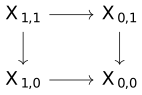
and every one of these is Segal for the copattern structure we’ve specified. But the generalized decomposition spaces for this pattern structure are precisely the pullback squares. So not only do we not have (Segal ⇒ decomposition), we in fact have precisely the reverse implication (decomposition ⇒ Segal)!
OK, sure, but isn’t this example is extremely synthetic? Well let’s shift back to the algebraic copattern $\Delta \times \Delta$, where Segality (over $\mathbf{Set}$) is the same as being a double category. Let’s take $\iota \colon [1] \to [2]$ to be the inert map sending $0,1$ to $1,2$ and $\alpha \colon [1] \to [4]$ to be the unique active map (taking $0,1$ to $0,4$). The square
![([1],[1]) \rar[tail,"\iota \times \id_{[1]}"] \dar[-act,"\id_{[1]} \times \alpha"'] \ar[dr, phantom, "\ulcorner" very near end] & ([2],[1]) \dar[-act,"\id_{[2]} \times \alpha"]\\
([1],[4]) \rar[tail,"\iota \times \id_{[4]}"'] & ([2],[4])](against-active-inert/diagram5.svg)
gets sent to
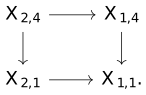
Since $X$ is Segal, $X_{m,n}$ is an $m$-by-$n$ grid of (compatible) squares in our double category. The horizontal maps are throwing away the leftmost column, while the vertical maps are composing squares in a column (vertically). It is definitely not the case that the above commutative square will be a pullback for most double categories – after all, an element in $X_{2,4}$ consists of eight squares, while $X_{1,4}, X_{2,1},$ and $X_{1,1}$ have only seven squares between them!
If I start with an algebraic copattern $C$, I’d really expect a $C$-decomposition space to be something that generalizes a Segal $C$-presheaf. We’ve seen that this fails even for $\Delta \times \Delta$. Perhaps there’s a more subtle notion of $C$-decomposition space than simply preserving active-inert pushouts, but I don’t currently have an idea of where to look. On the other hand, there are some copatterns where we indeed have Segal implies decomposition, for instance Burkin showed this was true for the dendroidal category $\Omega$ (as well as others like the cyclic dendroidal category). These at least meets the basic hurdle of (Segal ⇒ decomposition). It would be interesting to know precisely which algebraic copatterns have this nice property.